The race around language models is no longer only about the question "who has the best chatbot?". On July 24, 2026, AMD released Instella-MoE-16B-A3B and put a different question on the table: how far can the community reproduce an advanced AI stack outside the dominant hardware lane?
The announcement arrived on the official ROCm blog with weights, configurations, data mixtures, intermediate checkpoints and code. The model has 16 billion total parameters, but activates only 2.8 billion per token through a Mixture-of-Experts architecture. The promise is easy to state and hard to deliver: large-model capacity with inference cost closer to a much smaller model.

What AMD is really trying to prove
The simple reading is that this is another open model. The more interesting reading is that it is an infrastructure proof point. AMD says Instella-MoE was trained end to end on Instinct MI300X and MI325X, using ROCm, Primus and Miles. That matters because many labs and product teams still plan AI with the implicit assumption that the road usually runs through the same GPU supplier.
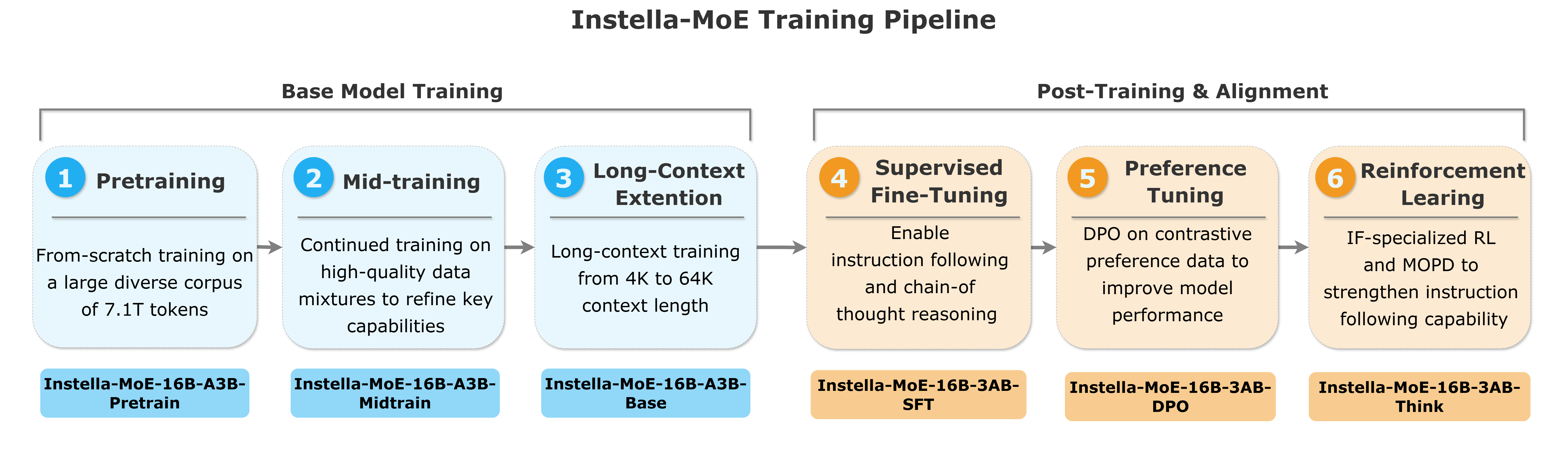
Instella-MoE does not try to win by raw scale alone. It tries to persuade through openness, efficiency and reproducibility. The pipeline includes pre-training, mid-training, long-context extension, SFT, DPO and reinforcement learning for the Think checkpoint. For researchers, that can be as valuable as the scores: an incomplete recipe helps only a little; a visible training chain helps explain where a model gains or loses capability.
MoE means fewer active parameters and more engineering
The Mixture-of-Experts design explains the headline number: 16B total, 2.8B active per token. Instead of touching every parameter at every step, the router selects experts. On paper, that lowers cost. In practice, it moves difficulty into GPU communication, load balancing, training stability and serving.
That is why details such as Gated Multi-head Latent Attention and FarSkip-Collective are more than jargon. According to AMD, FarSkip-Collective sped up pre-training by 12.7% by overlapping communication and computation, while the SGLang implementation reduced Time to First Token by up to 39.2% in expert-parallel serving. The point is not just to publish weights: it is to show that the operational bottleneck was attacked too.
Strong results, with clear limits
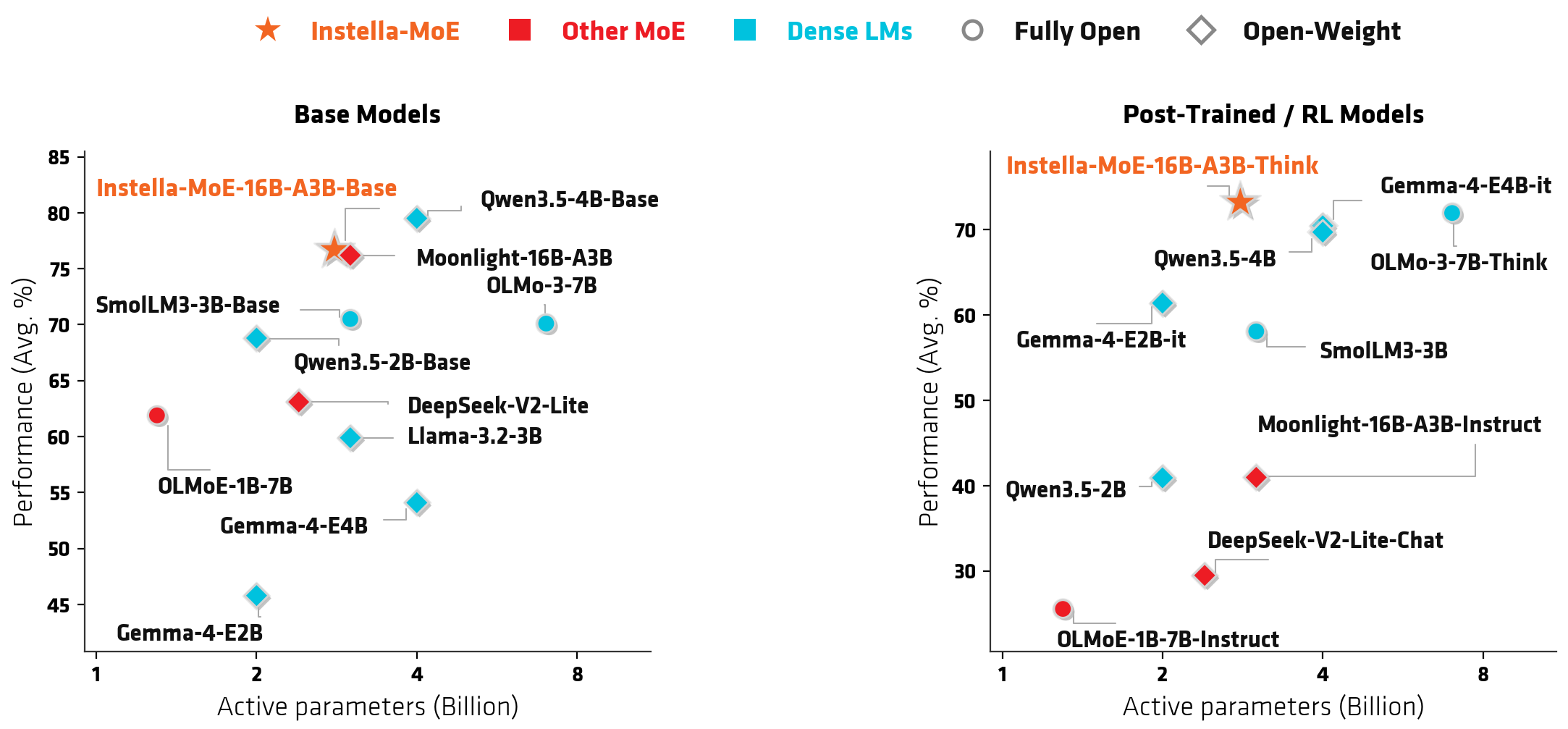
In the published benchmarks, the Base checkpoint reaches a 76.7 average on standard tests and keeps long-context capability out to 64K tokens. The Think checkpoint reaches 73.40 on AIME25 and improves instruction following after reinforcement learning. These are competitive numbers for an open model at this scale, especially when viewed against active parameter count.
But there is an important difference between "open" and "ready for everything". The Research RAIL license restricts the models to academic and research purposes, and the model page itself warns that there are no safety, factuality or multilingual guarantees. For teams experimenting with agents, internal tools or evaluation pipelines, that may be acceptable. For sensitive production use, it demands filtering, local testing and a careful license review.
Why it matters now
The release lands at a point where open models are no longer academic curiosities: they power IDEs, support bots, moderation systems, internal search and community automations. For independent projects, the value is less about running Instella-MoE in production immediately and more about studying how a full stack can be built, evaluated and audited.
If AMD can turn releases like this into a steady cadence, the conversation around open AI gains another axis: not just which weights are available, but which hardware and software can reproduce the path to them. Instella-MoE is a technical artifact, but the message is strategic.
Comments (0)
No comments yet.