Empty space sounds like the simplest thing in the Universe: no air, no matter, almost nothing. But a dead star thousands of light-years away has just reminded us that "nothing" can still have properties. NASA announced on August 5, 2026 that observations by the IXPE space telescope may have captured the strongest signal yet of vacuum birefringence, a prediction of quantum electrodynamics proposed roughly 90 years ago.
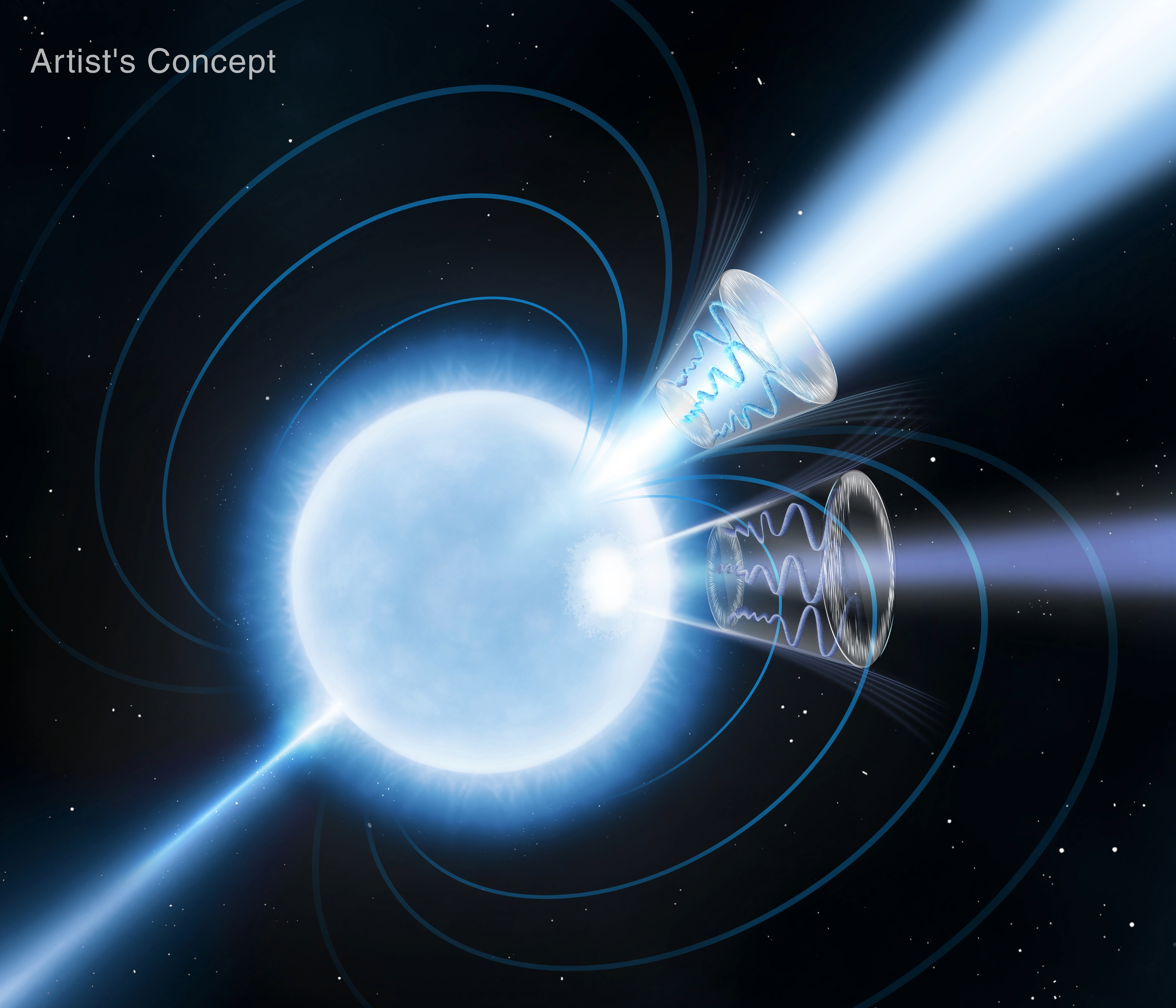
The target is 1E 1547.0-5408, a magnetar: the ultradense core of a dead star, with magnetic fields more than a trillion times stronger than Earth's. Between March and April 2025, IXPE observed this object for more than 140 hours, coordinated with NICER on the International Space Station and the Murriyang/Parkes radio telescope in Australia. The scientific paper was published in Nature on August 5.
Timeline
- 1936: quantum theory predicts that extreme magnetic fields can change how light travels through a vacuum.
- 2021: NASA launches IXPE, the first observatory dedicated to measuring X-ray polarization from extreme cosmic objects.
- March-April 2025: IXPE, NICER, and Murriyang/Parkes coordinate radio and X-ray observations of magnetar 1E 1547.0-5408.
- August 5, 2026: the team publishes Nature results showing very high X-ray polarization, reaching nearly 80% at certain rotation phases.
- Next step: new observations of magnetars will need to confirm whether this is truly the first direct portrait of vacuum birefringence.
The word "polarization" may sound technical, but the idea is familiar: it describes the orientation of light's vibration. Polarized sunglasses filter reflections because they preferentially pass one orientation. In this magnetar case, the team is not talking about glass or atmosphere. It is measuring X-rays crossing a region where empty space itself, stressed by an extreme magnetic field, behaves as if it were an optical medium.
According to NASA, normal surface-emission models for the star do not explain the strength of the signal. Nature reports phase-averaged polarization degrees of 65% at 2 keV and nearly 80% at specific phases, while remaining above 40% during the radio beam crossing. The combined radio and X-ray reading also fits better when the emission geometry is assumed to follow the magnetar's large-scale magnetic field.

That is why the news matters now. This is not just another beautiful observation of an exotic star; it is an attempt to test fundamental physics in a laboratory humans cannot build on Earth. Producing comparable magnetic fields would require exceeding any human technology by many orders of magnitude. The alternative is to use the cosmos as an accelerator, vacuum chamber, and test bench at the same time.
The Australia Telescope National Facility, involved through the Murriyang/Parkes observations, summarized the point simply: the magnetar had the right mix of geometry and intensity for searching this effect. If the interpretation holds, it opens a window into how light propagates when quantum rules stop being microscopic detail and start shaping astronomical signals.

Caution is still needed. NASA's own phrasing is careful: "may have proven", not "proved". The signal is strong, the models favor vacuum birefringence, but robust confirmation will come from repeated measurements, other magnetars, and independent analyses. Good science rarely ends with the first paper; it becomes interesting when a measurement survives attempts to take it apart.
Even so, there is something rare about this result: a direct bridge between a 1936 prediction and data gathered by modern satellites. For decades, vacuum birefringence lived as an elegant consequence of equations. In 2026, it may have left an observable signature in the light of a dead star rotating every 2.1 seconds. Empty space, it turns out, may not be empty of behavior.
Comments (0)
No comments yet.