The artificial intelligence race had a less flashy announcement this week than a new chatbot, but possibly a more decisive one for anyone paying data-center bills. Cerebras introduced CS-4 on August 18, 2026, the fourth generation of its wafer-scale system, now redesigned around a rack-scale platform called Nexus.
The company pitch is direct: if AI agents need to reason, verify answers, and call tools in a few seconds, inference stops being only an operating cost and becomes part of the product experience. In its investor release, Cerebras says CS-4 delivers up to 30 times more tokens per second per user than tested GPU systems, while also offering up to 10 times more throughput per watt than CS-3. First shipments are scheduled for this quarter.

What changed inside the rack
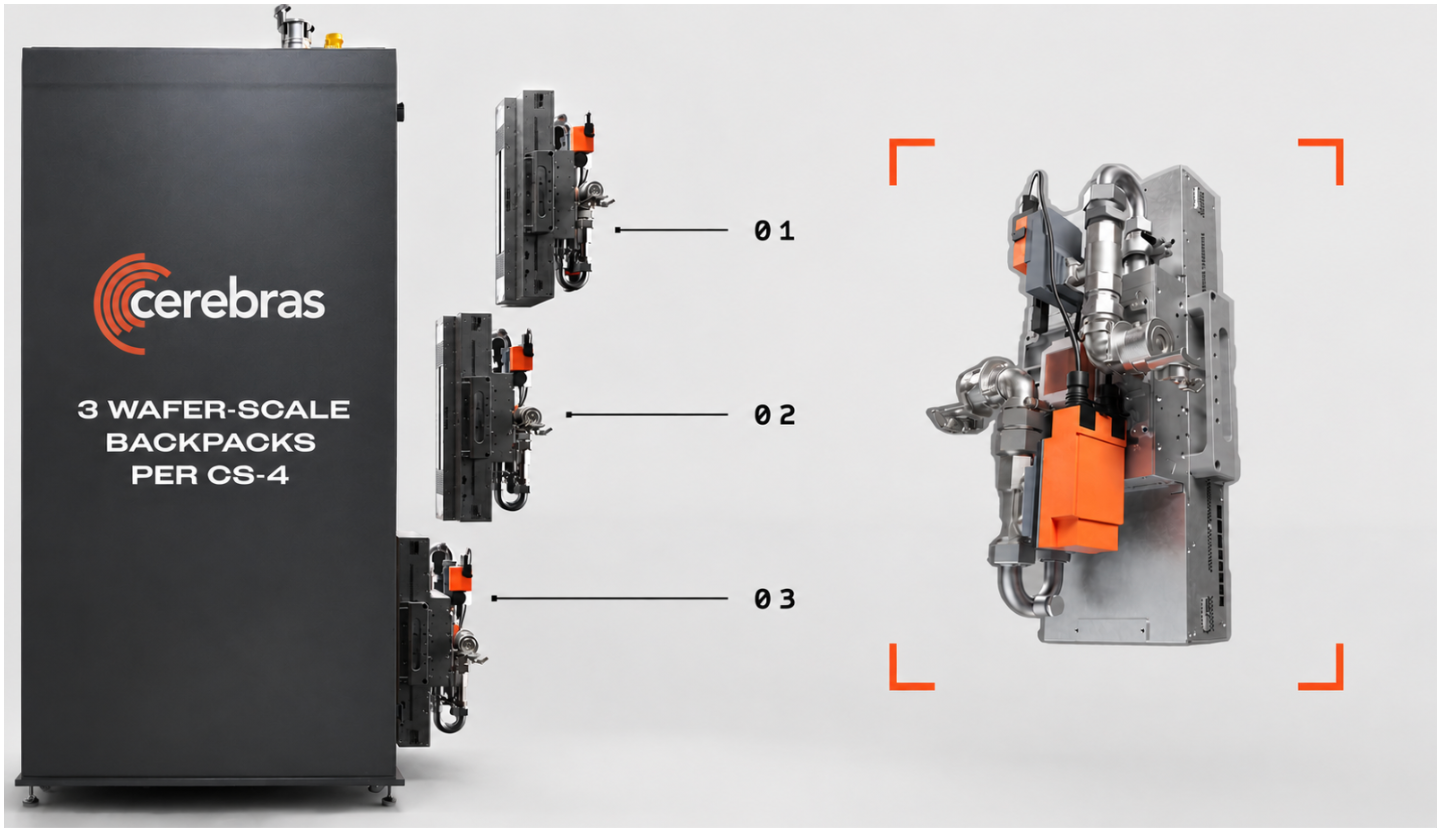
The headline number is 750 PFLOPS of AI compute in a system built from three Wafer Scale Engine 3 Turbo processors. Each wafer keeps the extreme scale that made Cerebras different: 4 trillion transistors, 900,000 AI-optimized cores, and 44 GB of SRAM integrated directly on the wafer. The practical change is the system around it: compute, power, cooling, and I/O have been reorganized to reduce losses and shorten the path between wafers.
Cerebras calls the central piece a Wafer-Scale Backpack, a rear-mounted module that brings power conversion, direct liquid cooling, high-speed I/O, and control electronics around the wafer. According to the company, that cuts components compared with the previous generation and reduces deployment time from days to hours. The promise is less about shiny new silicon and more about system engineering: bring power closer, simplify assembly, and make upgrades modular.
What changes for AI teams
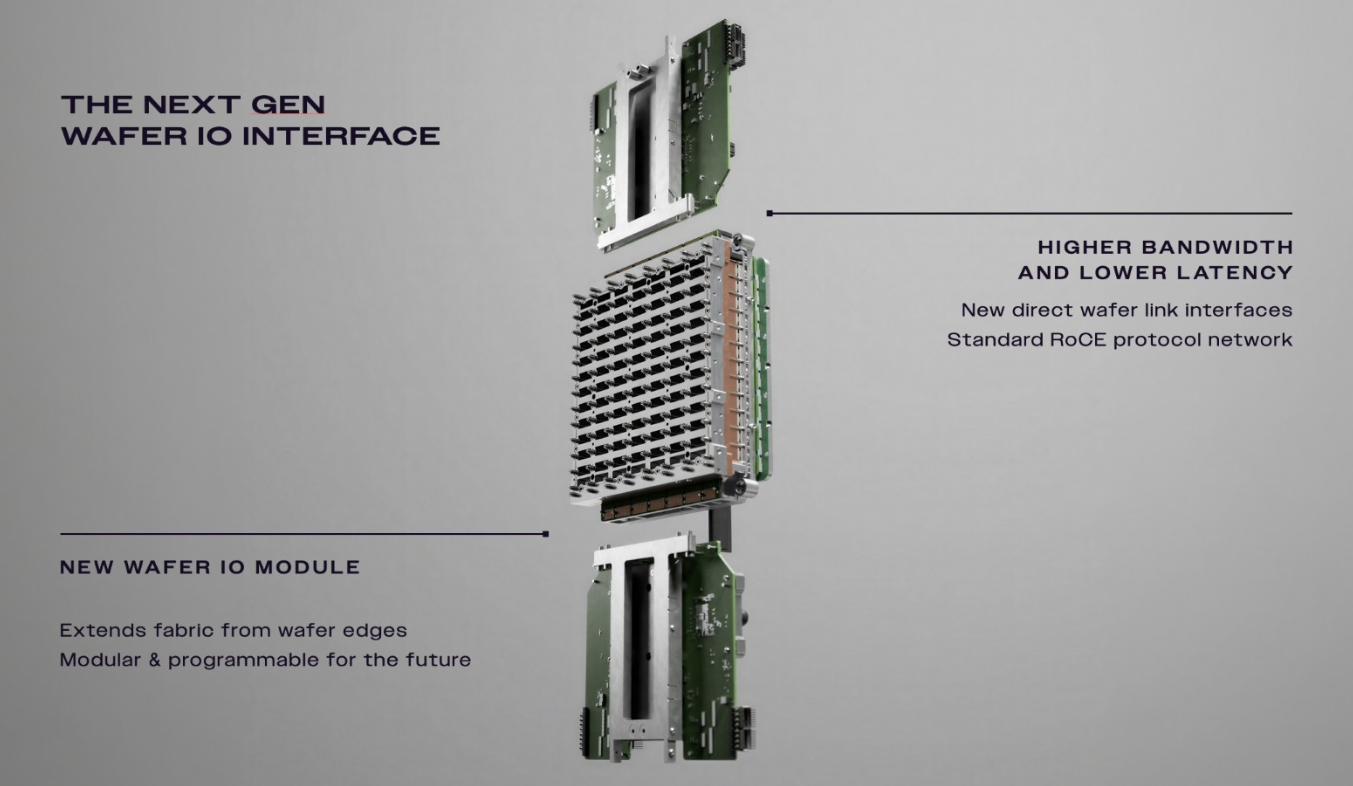
The most interesting piece is called Direct Wafer Links. Instead of pushing every accelerator-to-accelerator path through a traditional switching layer, CS-4 can link wafers inside and across racks with claimed latency as low as two microseconds. At the same time, it keeps RoCE v2 over Ethernet for existing infrastructure and heterogeneous designs, including scenarios where AMD Helios or AWS Trainium handle prefill while Cerebras performs low-latency decode.
For everyday applications, that may sound remote. The consequence reaches the product anyway: faster responses let agents take more internal steps within the same user wait time. CTO Sean Lie said in the release that being 30 times faster gives an agentic system room for much more reasoning, verification, or tool use in the same wall-clock time. If the comparison holds in production, the question becomes not only which model to use, but where each inference phase should run.
The caveat behind the benchmark
Some caution is needed. The Next Web notes that WSE-3 Turbo looks less like an entirely new silicon generation and more like a faster version of WSE-3, with the same 4 trillion transistors, the same 5 nm node, and the same integrated SRAM. Network World also highlights the other side of proprietary links: they may cut complexity and power between Cerebras systems, but they do not remove conventional networking, storage, orchestration, or integration with third-party accelerators.
Even so, CS-4 matters now because it shows where the AI contest is moving. After years of measuring models by public benchmarks, the advantage may come from racks that deliver tokens faster, spend less energy per answer, and fit better inside huge data centers. The news is not that GPUs stopped mattering. The news is that fast inference has become a hardware category of its own, with architecture, cables, cooling, and economics as important as the model that appears on screen.
Sofia Mendes Aug 25, 2026 8:02 AM
sending this to our mods rn the “Cerebras CS-4: The Rack Built to Speed Up AI Agents” thing is what our members kept asking
Inês Barbosa Aug 25, 2026 1:48 PM
@Sofia Mendes yeaah true i was thinking the same!