Pointing at crumbs on the floor and saying "clean this" sounds like a small scene. But small scenes are exactly where home robotics often breaks down: either you open an app, memorize rigid commands, or accept that your home becomes a constant data stream to the cloud. The Matic Cues update, announced on August 13, 2026, tries to remove that friction with a simple mix of voice, gestures, and local processing.
According to the Business Wire release, the feature is rolling out to existing Matic robots over the air and will be included on new units. The promise is ambitious: commands in more than 70 languages, gestures such as pointing at a dirty spot, and an architecture that keeps vision and wake-word detection on the robot itself.
What is Matic Cues?
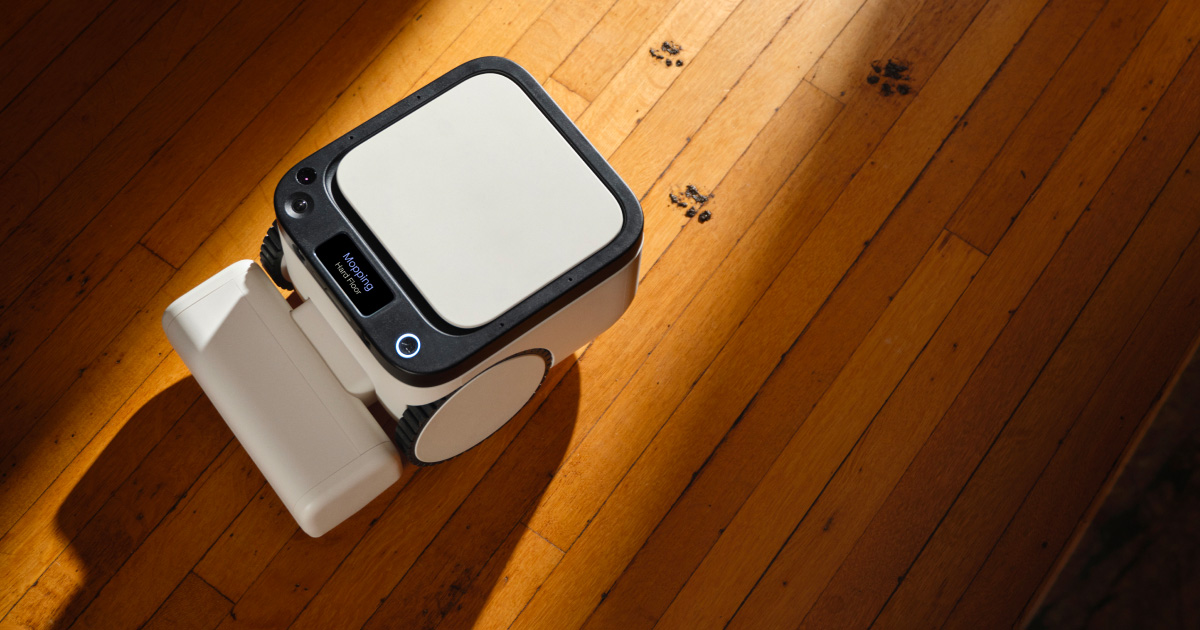
It is an interaction layer for the Matic robot vacuum and mop. Instead of drawing a zone in an app, a user can say "Hey Matic, clean this" and point at the problem. They can also ask it to clean a room, follow them, come to a spot, or run chained tasks. The official Hey Matic page presents the feature as a way to talk to the robot "like you would talk to a helper".
Why does it matter now?
The timing matters for two reasons. First, the update arrived during a week when home robotics was again discussing security, manufacturing origin, and privacy. Second, robot vacuums are now mature products: many already map homes, recognize objects, and integrate with assistants, but they still demand too much manual setup. If a family can simply point and speak, the usability barrier drops sharply.
What stays on the device?
In its technical post about voice data, Matic says "Hey Matic" wake-word detection runs locally, ambient audio is analyzed in the moment and discarded, and gesture detection uses the robot cameras without sending video outside the home. The company describes three edge models: wake word, voice direction, and gesture recognition.

So nothing goes to the cloud?
Not quite. After the chime, the spoken command is sent anonymously to the Gemini API for natural-language parsing and multilingual support. Matic states this trade-off directly: the goal is to support more commands and more languages now while it prepares a smaller local model for the most common requests. The important boundary is this: ambient audio and raw video stay on the robot; the command phrase, when Cues is enabled, can go to the cloud.
How did it perform in independent testing?
The Verge tested the feature on launch day and found gesture control the most convincing part: wake the robot, point at the dirt, and watch it clean the right area. It also noted the practical limitation that pointing from standing height can target a larger zone than intended. That is useful context: this is not magic, but a new interface with visible trade-offs.

What is the weak point?
Price and trust. Matic remains a premium product, listed at $1,245 before a planned September price increase. And privacy depends on details most buyers cannot audit alone: when the microphone turns on, what is discarded, what is sent, and how the promise changes with future updates. The advantage is that Matic is explaining the architecture in more detail than the average connected home gadget.
What does this say about the smart home?
The 2026 smart home is splitting between two ideas. One says everything improves when more data reaches larger models. The other says sensors inside the home need clear limits, local processing, and explicit consent. Matic Cues tries to sit in the middle: it uses cloud AI for broad language understanding, while keeping physical perception of the home at the edge. If that compromise works, the future of the home robot may not be another app, but a better understanding of the gesture we already make with our hand.
Inês Barbosa Aug 25, 2026 8:03 AM
wait is this the ting everyone was talking about??